Foxe's Book of Martyrs A History of Protestantism
สรุปใจความสำคัญ
- First published in 1563 by John Day.
- The 1570 edition expanded to two volumes and over 2,300 pages with 150 woodcuts.
- Originally titled 'Actes and Monuments', but popularly known as 'Book of Martyrs'.
- It aimed to establish a continuity of Protestant piety from apostolic times to the Reformation.
The Actes and Monuments, popularly known as Foxe's Book of Martyrs, is a seminal work of Protestant history and martyrology authored by the English historian John Foxe. First published in 1563 by John Day, the work serves as a polemical account of the sufferings of Protestants under the Catholic Church, with a particular focus on England and Scotland.
Background and Purpose
Following the Reformation, Catholic apologists criticized Protestant doctrines as novelties. In response, John Foxe, a Calvinist Anglican, sought to establish a historical continuity of "proto-Protestant" piety, tracing a line of faith from apostolic times through to the Reformation. By documenting the persecution of believers, Foxe aimed to prove that the Protestant faith was not a new invention, but a return to the primitive church.
Bibliographic Details and Evolution
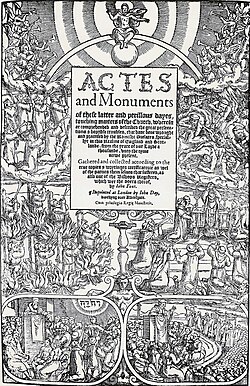
The first edition of the book was produced at what Foxe described as "breakneck speed." It was a massive single-volume work, exceeding 1,500 pages and weighing as much as a small infant. Its full title was Actes and Monuments of these Latter and Perillous Days, Touching Matters of the Church. The text focused on the "persecutions and horrible troubles" wrought by Roman Prelates in England and Scotland.
By the 1570 edition, the work had expanded significantly, growing to two volumes and over 2,300 folio pages. The number of woodcuts increased from 60 to 150, as Foxe updated the material to include his own contemporaries. Because these events were current, the illustrations were newly cut to depict specific details, linking the suffering of the English Protestants to the "primitive tyme" and the reign of King Henry VIII.
The Popular Name "Book of Martyrs"
While the official title was Actes and Monuments, the work became widely known as the Book of Martyrs. This popular naming is attributed to Bishop Edmund Grindal, who referred to it as such, and the name eventually stuck. Despite Foxe's own attempts to correct this misconception in later editions, the popular title continued to prevail.
Impact and Legacy
The book was highly influential in England and Scotland, shaping lasting popular notions of Catholicism and the perception of religious persecution. By framing the Protestant experience as a continuation of the same struggle faced by the early Christians, Foxe created a powerful narrative of identity and faith for the Protestant world.
คำถามที่พบบ่อย
What is Foxe's Book of Martyrs?
It is a work of Protestant history and martyrology by John Foxe, documenting the sufferings of Protestants under the Catholic Church, particularly in England and Scotland.
Who was the author of Foxe's Book of Martyrs?
The English historian John Foxe, a Calvinist Anglican.
Why is it called the 'Book of Martyrs' if that wasn't the original title?
The name was popularized by Bishop Edmund Grindal and became the common way the public referred to the work, despite the author's efforts to correct it.