Haitian Aviation Corps History, Equipment, and Modernization
สรุปใจความสำคัญ
- The Haitian Aviation Corps was founded in 1942 with U.S.-supplied aircraft.
- The corps was disbanded in 1994 following Operation Uphold Democracy.
- Current modernization efforts involve training partnerships with Argentina, Colombia, Mexico, and Spain.
The Haitian Military Aviation Corps (French: Corps d'Aviation Militaire) serves as the air force component of the Armed Forces of Haiti. Throughout its history, the corps has transitioned from a strategic patrol force to a period of complete disbandment, and is currently undergoing a slow process of remobilization and modernization.
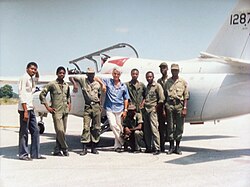
History and Evolution
Founded in 1942 with aircraft supplied by the United States, the Haitian Air Corps was initially tasked with communication, transport, and patrolling Haitian territory. Its first commander was Colonel Edward Roy, and it operated primarily out of Bowen Field, a former U.S. Marine Corps airfield, with Môle-Saint-Nicolas Airport serving as a secondary base.
World War II and Early Combat Capability
During World War II, the corps was actively engaged in the Caribbean anti-submarine warfare campaign against the German Navy. By 1950, the force expanded its combat capabilities with the acquisition of six F-51D Mustangs, which remained active through the Duvalier period.
Equipment Transitions
Over the following decades, the corps updated its fleet through various international acquisitions:
- 1970s: The Mustangs were replaced by French T-28 Trojans in 1970, followed by O-2As in 1975.
- 1980s: The corps introduced its first jet aircraft, the SIAI-Marchetti S-211, alongside SF-260s.
- 1990s: The S-211 jets were sold in 1990 to private U.S. companies and the Singapore Air Force.
Disbandment and Operation Uphold Democracy
By the time of the U.S. invasion in 1994 (Operation Uphold Democracy), the Haitian Air Corps played a negligible role in national defense. The inventory consisted largely of World War II-era aircraft in poor condition, including O-57 Grasshoppers, BT-13 Valiants, a C-78 Bobcat, and a C-46 Commando. Consequently, the air corps was disbanded along with the rest of the armed forces in 1994.
Modernization and Current Status
Since the remobilization of the Armed Forces in 2017, the corps has reclaimed its main garrison at the Military Aviation base in Clercine, located near Toussaint Louverture International Airport.
International Cooperation
Haiti is currently seeking international partnerships to rebuild its aerial capabilities:
- Spain: Discussions have been held regarding the reorganization and modernization of the Aeronautical Corps.
- Argentina: The Argentine Air Force provides technical assistance and training via the Escuela de Aviación Militar.
- Mexico: Mexico has committed to providing pilot training for selected Haitian servicemen.
- Colombia: The Colombian Aerospace Force is expected to train 250 recruits.
- Taiwan: Taiwan has offered assistance to improve the military's aerial transport capacities.
Past Aircraft Inventory
| Manufacturer/Model | Role | Notes |
|---|---|---|
| North American F-51D Mustang | Fighter | 6 delivered in 1950; retired 1973/74 |
| North American T-28 Trojan | Fighter Trainer | 12 ex-French Air Force delivered 1973 |
| Cessna O-2A Skymaster | Observation | 8 delivered 1975 |
| SIAI-Marchetti S-211 | Jet Trainer | Retired 1990; sold to USA and Singapore |
| de Havilland Mosquito | Light Bomber | 8 ex-Royal Air Force delivered 1946 |
| Aermacchi SF.260TP | Warrior Trainer | Used in later years |
คำถามที่พบบ่อย
When was the Haitian Aviation Corps founded?
The Haitian Air Corps was founded in 1942, with its initial operations based at Bowen Field.
Why was the Haitian Aviation Corps disbanded?
It was disbanded in 1994 along with the rest of the armed forces following the U.S. invasion known as Operation Uphold Democracy.
Where is the main base of the Aviation Corps located?
The main garrison is the Military Aviation Base (Base de l'Aviation Militaire) in Clercine, near Toussaint Louverture International Airport in Port-au-Prince.