Interior Alaskan Wolf The Yukon Wolf's Guide
สรุปใจความสำคัญ
- The Interior Alaskan wolf is also known as the Yukon wolf (Canis lupus pambasileus).
- They are characterized by larger teeth and skulls compared to the Northwestern wolf of similar size.
- Their diet primarily consists of moose and caribou, depending on the specific region of their habitat.
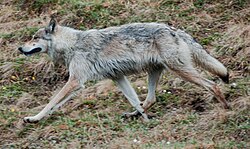
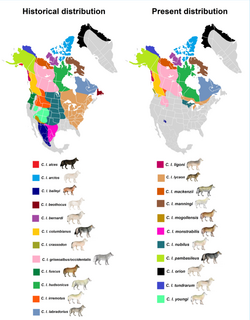
The Interior Alaskan wolf, frequently referred to as the Yukon wolf, is a formidable subspecies of the gray wolf. Its native range spans across the rugged landscapes of Interior Alaska, the Yukon, the Northwest Territories, and parts of British Columbia.
Taxonomy and Identification
First described in 1905 by American zoologist Daniel Elliot as Canis pambasileus (the "autocrat timber wolf"), this subspecies was identified based on a specimen from the Susitna River region. Elliot noted that this wolf possessed larger, heavier teeth and a larger skull compared to the Northwestern wolf (C. l. occidentalis) of similar size. In 1944, Edward Goldman officially recognized it as Canis lupus pambasileus.

Physiology and Pack Dynamics
Physical Description
The Interior Alaskan wolf is known for its impressive size. Males average around 56.3 kg (124 lb), while females average 38.5 kg (85 lb), though individual weights can vary significantly from 32 kg to 60 kg. Some exceptional specimens have been recorded at much higher weights, though it is noted that large wolves can carry significant amounts of prey in their stomachs, which can skew weight measurements.
Their coat colors are diverse, ranging from white to black, with tawny grey or tan being the most common. These wolves typically live between 4 to 10 years, with the oldest recorded reaching 12 years.
Pack Habits
Social structure is critical for the Interior Alaskan wolf. Average pack sizes range from 7 to 9 individuals, typically consisting of a mated pair and their offspring. Generally, only the alpha pair breeds, and litters usually consist of 4 to 6 pups. Lone wolves may travel up to 500 km to find a mate.
Distribution and Habitat
These wolves inhabit boreal forests, alpine regions, subalpine zones, and Arctic tundra. They are found throughout the interior of Alaska and the Yukon, excluding the tundra of the Arctic Coast. Population density is closely tied to the availability of prey; for instance, the Teslin area in Yukon has a higher density (9 wolves per 1,000 sq km) compared to Northern Yukon (3 wolves per 1,000 sq km).
Diet and Hunting Strategies
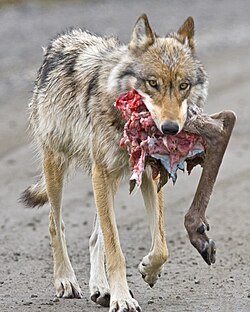
The diet of the Interior Alaskan wolf varies by region:
- Southern Yukon: Moose is the primary prey, followed by boreal woodland caribou and Dall sheep.
- North Slope: Barren-ground caribou is the main food source.
When hunting moose, wolves typically target calves or elderly animals. While the success rate for a single moose hunt is approximately 10%, a pack usually secures a moose every 5 to 6 days, providing food for several days. Caribou are more likely to flee, making them a more frequent kill (roughly every 3 days in winter).
History and Conservation
Historically, Aboriginal populations hunted these wolves for their fur, a practice that continued into the 1800s. In the 1950s, public stigma led to wolf-poisoning programs. By the 1980s, the Yukon government implemented the Yukon Wolf Conservation and Management Plan to balance wolf populations with prey species like caribou. This plan evolved into more rigid conservation guidelines in the 2000s, emphasizing public awareness and stricter hunting laws to ensure the long-term survival of the subspecies.
คำถามที่พบบ่อย
What is the average pack size of an Interior Alaskan wolf?
The average pack size is between 7 and 9 wolves, typically consisting of a mated pair and their offspring.
Where is the Interior Alaskan wolf natively found?
They are native to Interior Alaska, the Yukon, the Northwest Territories, and parts of British Columbia, primarily in boreal forests and tundra.
What is the primary prey of the Yukon wolf in the southern Yukon?
In the southern Yukon, the primary prey is moose, followed by boreal woodland caribou and Dall sheep.