Philip Herbert, 4th Earl of Pembroke Courtier and Politician
สรุปใจความสำคัญ
- Philip Herbert was one of the two brothers to whom the First Folio of Shakespeare's works was dedicated.
- He was a Knight of the Garter and a Knight of the Bath.
- He held multiple Lord Lieutenancies, including those of Kent, Buckinghamshire, Somerset, and Cornwall.
Philip Herbert, 4th Earl of Pembroke and 1st Earl of Montgomery (10 October 1584 23 January 1650), was a prominent English courtier, nobleman, and politician who navigated the complex political landscapes of the reigns of James I and Charles I. A member of the high nobility, he is perhaps most famously remembered today as one of the 'incomparable pair of brethren' to whom the First Folio of William Shakespeare's collected works was dedicated in 1623.
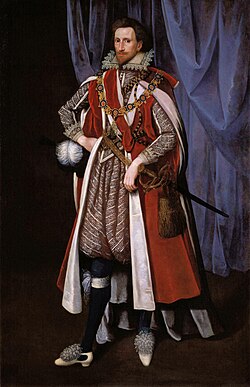
Early Life and Education
Born at Wilton House, Philip was the son of Henry Herbert, 2nd Earl of Pembroke, and Mary Sidney. His mother was the sister of the renowned poet Sir Philip Sidney, after whom he was named. In 1593, at the age of nine, Philip began his studies at New College, Oxford, though he left the institution after only a few months.
Rise as a Favourite of James I
Philip made his first appearance at court in 1600. Upon the accession of James I in 1603, he quickly became a royal favourite. His shared interests in hunting and hawking initially drew the king's attention. By May 1603, James I appointed him a gentleman of the privy chamber, and in July, he was made a Knight of the Bath.
His rise was meteoric. In 1604, he married Susan de Vere, the daughter of the 17th Earl of Oxford, with the enthusiastic support of James I. That same year, he was elected Member of Parliament for Glamorgan. In 1605, the king bestowed upon him the titles of Baron Herbert of Shurland and Earl of Montgomery. He was also granted an honorary MA from Oxford during a royal visit.
Despite his royal favour, Montgomery was known for a volatile temperament. He was involved in several violent, often unprovoked assaults and quarrels, including a noted dispute with the Earl of Southampton in 1610 and another with Lord Howard de Walden in 1617. However, he was consistently forgiven by King James I.
Colonial Ventures and Political Power
Philip Herbert took a keen interest in the burgeoning English colonial efforts. He was involved with several joint-stock companies, including the Virginia Company (1612), the Northwest Passage Company (1612), and the Honourable East India Company (1614). Under Charles I, his interest in colonial expansion continued, and he became an incorporator of the Guiana Company in 1626 and received grants for the islands of Trinidad, Tobago, and Barbados in 1628.
Continued Influence under Charles I
Following the accession of Charles I in 1625, Herbert continued to enjoy royal favour. He served as Lord Chamberlain and was appointed Lord Lieutenant of Buckinghamshire in 1628. In 1630, he succeeded his older brother as the 4th Earl of Pembroke, inheriting several titles and positions, including Lord Lieutenant of Somerset and Cornwall, as well as the high steward of the Duchy of Cornwall.
Personal Life and Family
Herbert married twice. His first wife, Susan de Vere, died in 1629. In 1630, he remarried Lady Anne Clifford, the daughter of the 3rd Earl of Cumberland. He maintained an extensive household, with over 150 staff members at his residence in Wilton House.
คำถามที่พบบ่อย
Who was Philip Herbert, 4th Earl of Pembroke?
He was an English courtier, nobleman, and politician during the reigns of James I and Charles I, known for his royal favour and political influence.
What was his connection to William Shakespeare?
He and his brother William were the 'incomparable pair of brethren' to whom the First Folio of Shakespeare's collected works was dedicated in 1623.
Which colonial companies was he involved with?
He was a member of the council of the Virginia Company, an original incorporator of the Northwest Passage Company, and a member of the Honourable East India Company.
บทความที่เกี่ยวข้อง
History
John Mowbray, 3rd Duke of Norfolk Life and Legacy
อ่านบทความฉบับเต็มอ่านต่อ →Charles I
Robert Kerr เอิร์ลแห่งแอนครามรุ่นที่ 1 ขุนนางและกวีชาวสกอต
อ่านบทความฉบับเต็มอ่านต่อ → 03ประวัติบุคคล
ประวัติบุคคล