Preamble to the Constitution of India History and Significance
สรุปใจความสำคัญ
- The Preamble is based on the Objectives Resolution moved by Jawaharlal Nehru on December 13, 1946.
- The Preamble has been amended only once, in 1976, adding the words 'socialist', 'secular', and 'integrity'.
- The Kesavananda Bharati case (1973) established that the Preamble is part of the 'Basic Structure' of the Indian Constitution.
The Preamble to the Constitution of the Republic of India serves as the introductory statement that outlines the guiding purpose, principles, and philosophy of the Indian state. Based on the Objectives Resolution, it defines India as a Sovereign, Socialist, Secular, Democratic Republic and ensures justice, liberty, equality, and fraternity for all its citizens.
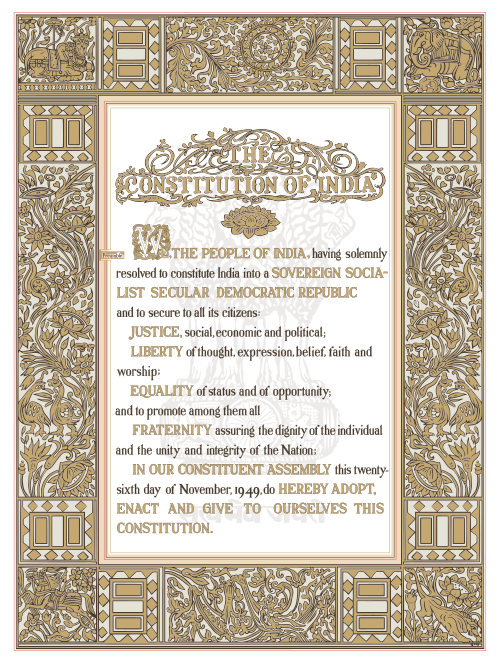
The Text of the Preamble
As amended up to July 2024, the Preamble reads:
WE, THE PEOPLE OF INDIA, having solemnly resolved to constitute India into a SOVEREIGN SOCIALIST SECULAR DEMOCRATIC REPUBLIC and to secure to all its citizens:IN OUR CONSTITUENT ASSEMBLY this twenty-sixth day of November, 1949, do HEREBY ADOPT, ENACT AND GIVE TO OURSELVES THIS CONSTITUTION.
- JUSTICE, social, economic and political;
- LIBERTY of thought, expression, belief, faith and worship;
- EQUALITY of status and of opportunity; and to promote among them all
- FRATERNITY assuring the dignity of the individual and the unity and integrity of the Nation;
Historical Background
The Preamble was initially drafted by Jawaharlal Nehru and is based on the Objectives Resolution moved by him in the Constituent Assembly on December 13, 1946. It was accepted on January 22, 1947, and adopted on November 26, 1949, eventually coming into force on January 26, 1950.
Philosophical Foundations
Dr. B. R. Ambedkar emphasized that liberty, equality, and fraternity are inseparable principles of life. He argued that without equality, liberty would lead to the supremacy of a few, and without fraternity, these principles could not be sustained as a natural course of things.
Debates and Design
During the drafting process, there were significant debates regarding the naming of the country and the inclusion of religious or personal names. Suggestions to rename India as the 'Union of Indian Socialistic Republics' were rejected. Furthermore, votes against including the name of 'God' were cast by 68 members, and the suggestion to include Mahatma Gandhi's name was disapproved by Brajeshwar Prasad, who felt the Constitution was not 'Gandhian' in nature.
The original Preamble page was designed and decorated by Beohar Rammanohar Sinha of Jabalpur, with calligraphy performed by Prem Behari Narain Raizada. The artwork was endorsed by Acharya Nandalal Bose.
Legal Status and the 'Basic Structure'
The legal status of the Preamble has evolved through several landmark Supreme Court cases:
- Berubari Case (1960): The Court initially ruled that the Preamble is not an integral part of the Constitution and is therefore not enforceable in court.
- Kesavananda Bharati Case (1973): The Court overruled its previous decision, declaring that the Preamble is part of the Constitution and forms part of the "Basic Structure." This means that while the Preamble can be amended under Article 368, the basic structure cannot be destroyed.
- LIC of India Case (1995): The Supreme Court reaffirmed that the Preamble is an integral part of the Constitution.
Amendments to the Preamble
The Preamble has been amended only once in history. On December 18, 1976, during the Emergency in India under the government of Indira Gandhi, the words "socialist", "secular", and "integrity" were added to the Preamble.
คำถามที่พบบ่อย
Is the Preamble to the Indian Constitution enforceable in a court of law?
No, the Preamble is non-justiciable, meaning it is not enforceable in a court of law on its own, but it is used by the courts to interpret ambiguous areas of the Constitution.
Who designed the original Preamble page?
The original Preamble page was designed and decorated by Beohar Rammanohar Sinha, with calligraphy by Prem Behari Narain Raizada.
Which case established that the Preamble is part of the Constitution?
The Supreme Court in the Kesavananda Bharati case (1973) over-ruled the Berubari case (1960) and recognized the Preamble as an integral part of the Constitution.