Theological Determinism Divine Foreknowledge and Free Will
สรุปใจความสำคัญ
- Theological determinism is the thesis that all events are pre-ordained by divine beings or destined to occur due to divine omniscience.
- Strong theological determinism posits that a creator deity dictates all events, while weak theological determinism focuses on divine foreknowledge.
- Theological compatibilism (soft determinism) argues that divine foreknowledge is compatible with human free will.
Theological determinism is a form of predeterminism which states that all events that happen are pre-ordained, and/or predestined to happen, by one or more divine beings, or that they are destined to occur given the divine beings' omniscience. This concept exists across a wide array of religions and philosophical systems, including Jainism, Judaism, Christianity, and Islam, as well as among proponents of Classical pantheism such as the Stoics and philosophers like Baruch Spinoza.
Categorization of Theological Determinism
Theological determinism is generally categorized into two primary forms: strong and weak.
Strong Theological Determinism
Strong theological determinism is based on the concept of a creator deity dictating all events in history. Under this view, everything that happens has been predestined to happen by an omniscient, omnipotent divinity. This form of determinism is fundamentally incompatible with metaphysical libertarian free will, as it claims that free will does not exist and that God has absolute control over a person's actions.
Weak Theological Determinism
Weak theological determinism is based on the concept of divine foreknowledge. It suggests that because God's omniscience is perfect, what God knows about the future will inevitably happen, meaning the future is already fixed. This form is affirmed by Jainism, particularly the Kanji sect, which views belief in it as a necessary condition for liberation. Proponents often cite Einstein's view that events do not happen, but already exist and are seen on a "Time Machine".
While some philosophers argue that the weaker version does not constitute "theological determinism" unless libertarian free will is denied as a consequence, others see it as a form of causal determinism where the antecedent conditions are the nature and will of God.
Free Will and Theological Determinism
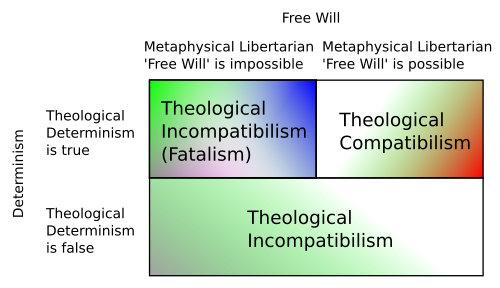
The implications for metaphysical libertarian free will vary depending on the philosophical interpretation of omniscience.
- Hard Theological Determinism: This is equivalent to theological fatalism. It claims that free will does not exist and that divine control or foreknowledge makes human actions inevitable. This is a form of theological incompatibilism.
- Soft Theological Determinism: Also known as theological compatibilism, this view holds that humans (or all organisms, as per Jainism) have free will to choose their actions, even though God knows their actions before they happen. In this view, God's providence is compatible with voluntary choice.
The Argument for Theological Fatalism
The basic argument for theological fatalism in the case of weak theological determinism is as follows:
- Assume divine foreknowledge or omniscience.
- Infallible foreknowledge implies destiny (it is known for certain what one will do).
- Destiny eliminates alternate possibility (one cannot do otherwise).
- Assert incompatibility with metaphysical libertarian free will.
Theological compatibilists attempt to resolve this by denying the truth value of future contingents (Aristotle), asserting differences in non-temporal knowledge (Boethius, Thomas Aquinas, and C. S. Lewis), or denying the Principle of Alternate Possibilities.
Historical Perspectives
Throughout history, many theologians and philosophers have debated the own nature of human agency. For instance, Saint Thomas Aquinas, a medieval Roman Catholic theologian, strongly believed that humanity possessed free will, despite the divine nature of the universe.
คำถามที่พบบ่อย
What is the difference between strong and weak theological determinism?
Strong theological determinism posits that a creator deity actively dictates all events in history, whereas weak theological determinism suggests that events are inevitable because an omniscient deity knows them in advance.
sWhat is theological fatalism?
Theological fatalism is a form of hard theological determinism where divine foreknowledge is seen as incompatible with the existence of metaphysical libertarian free will.
How do theological compatibilists explain free will?
Theological compatibilists argue that God's knowledge of future actions does not cause those actions to happen, meaning humans still make voluntary choices despite the outcome being known to divine beings.