What is a Tipping-Point State in US Presidential Elections?
สรุปใจความสำคัญ
- The tipping-point state is the first state in a list ordered by decreasing margin of victory that gives the winning candidate a majority in the Electoral College.
- The concept was popularized by Nate Silver and FiveThirtyEight.
- The tipping-point state can only be determined after all votes are counted and certified to determine accurate margins.
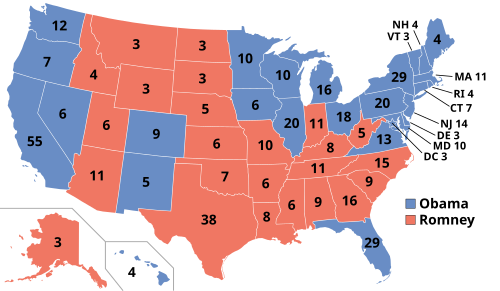
- Colorado was the tipping-point state for Barack Obama's victory in the 2012 presidential election.
In the analysis of United States presidential elections, the term tipping-point state is used to identify the median state that determines the outcome of the Electoral College. To find the tipping-point state, states are listed in order of decreasing margin of victory for the winning candidate. The tipping-point state is the first state in that list where the combined electoral votes of all states above it reach the majority threshold (currently 270 electoral votes).

The Logic and Counterfactuals of the Tipping Point
The concept of a tipping-point state suggests a counterfactual scenario: if the nationwide vote margin were shifted uniformly, but the order of states by vote margin remained the same, the tipping-point state represents the state where a change in the winner would result in a change in the national winner. Essentially, it is the "median" state of the election.
While typically the same, the tipping-point state can differ for the first-place and second-place candidates if there are more than two candidates receiving electoral votes or if a shift in results would lead to a tie in the Electoral College. Additionally, the disposition of faithless electors can impact the tipping point.
Origin and Popularization
The concept was popularized by Nate Silver and his site, FiveThirtyEight. Through the "Tipping Point Index," the site regularly predicts which state will become the tipping-point state in an upcoming election. Notable past predictions include Ohio in 2012, Florida in 2016, and Pennsylvania in 2020.
Tipping-Point State vs. Election Night Projections
It is important to distinguish the tipping-point state from the chronological order in which results are reported. Media decision desks project winners of states as they come in, and a state is often announced as the "winning state" when it gives a candidate enough electoral votes to reach 270. However, the tipping-point state can only be determined after all votes are counted and certified, as it is the based on the final, accurate vote margins.
For example, in the 2020 election, the projection of Joe Biden winning Pennsylvania made him the projected winner of the Electoral College, but his actual tipping-point state was Wisconsin, which had been called for him three days earlier.
Example The 2012 Presidential Election
In the 2012 election, Barack Obama defeated Mitt Romney, winning 332 electoral votes to 206. To win, Obama needed 270 electoral votes. He would have still won the majority even if he had lost Florida, Ohio, and Virginia (his smallest margins of victory). However, if he had lost those three plus Colorado, losing Colorado would have dropped him below 270. Therefore, Colorado was the tipping-point state for Obama's victory in 2012.
Summary of Tipping-Point States
Since 1832, 20 different states have served as the tipping-point state for the winning candidate. This metric provides a deeper understanding of how close an election was overall, rather than just focusing on the landslide or narrow margins in individual swing states.
คำถามที่พบบ่อย
What is a tipping-point state?
A tipping-point state is the median state in a US presidential election, identified by ordering states by the winning candidate's margin of victory and finding the first state that pushes the total electoral votes to a majority (270).
Is the tipping-point state the same as the state that 'decides' the election on election night?
No. The tipping-point state is based on final vote margins, whereas the state that 'decides' the election on election night is based on the chronological order of results being reported.
Can there be more than one tipping-point state?
Yes, in cases where no candidate reaches 270 electoral votes or if a shift in results would lead to atie in the Electoral College, different candidates may have different tipping-point states.