PhET Interactive Simulations Free Science and Math Tools
สรุปใจความสำคัญ
- Founded in 2002 by Nobel Laureate Carl Wieman at the University of Colorado Boulder.
- Offers over 125 free interactive simulations in physics, chemistry, biology, earth science, and mathematics.
- Simulations are translated into over 121 different languages to increase global accessibility.
- Chosen as the 2011 Microsoft Education Tech Award laureate.
PhET Interactive Simulations, a project at the University of Colorado Boulder, is a non-profit open educational resource project that creates and hosts explorable explanations. Founded in 2002 by Nobel Laureate Carl Wieman, the project was born from Wieman's vision to improve the way science is taught and learned. Their stated mission is to advance science and math literacy and education worldwide through free interactive simulations.
History and Foundation
After winning the Nobel Prize in 2001, Carl Wieman became deeply involved in improving science education. He noticed that during his public lectures, the simulations he used to explain complex physics concepts—such as the Bose-Einstein condensate—were often the most memorable and effective learning tools for his audience. This realization led him to found PhET using grants from the National Science Foundation, the Kavli Foundation, and a portion of his own Nobel Prize money.
Unlike earlier simulations, PhET simulations are designed to be interactive, allowing users to change conditions and observe the results in real-time, rather than being static videos. In 2007, Wieman moved to Vancouver, British Columbia, and the leadership of the project transitioned to current director Dr. Katherine Perkins.
Organization and Development
PhET is part of the University of Colorado Boulder, member of the Association of American Universities. The development team consists of approximately 16 members, including professors, post-doctoral students, researchers, education specialists, and software engineers. Each simulation is created through a collaborative process involving a content expert, a teacher, and an educational researcher to ensure pedagogical effectiveness.
Design and Educational Impact
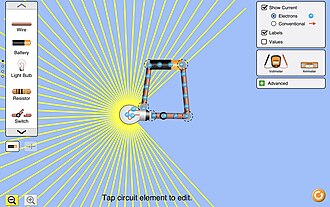
PhET simulations use an intuitive, game-like environment where students can learn through exploration. By making the "invisible visible," they connect science ideas to real-world phenomena. The design process involves identifying conceptually difficult learning goals, storyboarding, and rigorous user testing with students in classrooms before release.
Research conducted by the PhET team has demonstrated that when students use these simulations in addition to traditional labs, their conceptual understanding of science and mathematics improves significantly.
Usage by Educators
While PhET develops the simulations, the community of teachers and publishers develops the educational activities that utilize them. These activities follow Open Education Practices (OEP), allowing educators worldwide to freely adapt and adapt the tools for their classroom needs.
คำถามที่พบบ่อย
What is PhET Interactive Simulations?
PhET is a non-profit open educational resource project that provides free, research-based interactive simulations for science and math education.
Who founded PhET?
PhET originally stood for Physics Education Technology and was founded by Nobel Laureate Carl Wieman in 2002.
How are PhET simulations designed?
They are designed using research-based practices, and each simulation is developed by a team including a scientist, a teacher, and an educational researcher to ensure they are effective for learning.
บทความที่เกี่ยวข้อง
 01การศึกษา
University of Colorado Boulder
มหาวิทยาลัยโคโลราโด โบลเดอร์ (CU Boulder) สถาบันวิจัยชั้นนำระดับโลก
อ่านบทความฉบับเต็มอ่านต่อ →การศึกษา
Wikiversity แหล่งเรียนรู้เสรีและชุมชนการเรียนรู้ระดับโลก
อ่านบทความฉบับเต็มอ่านต่อ →STEM education