William Farel The Fiery Pioneer of the Francophone Reformation
สรุปใจความสำคัญ
- William Farel was the primary catalyst for John Calvin's stay in Geneva, which established the city as a 'Protestant Rome'.
- He was a member of the Cercle de Meaux, a group of humanist scholars who sought reform within the Catholic Church.
- He published the first French-language work of the Reformation, 'Le Pater noster et le Credo en françoys' in 1524.
William Farel (French: Guillaume Farel; 1489–1565) was a French evangelist and Protestant reformer who played a pivotal role in establishing the Reformed Church in French-speaking Switzerland. He is most famously remembered for his persistence in persuading John Calvin to remain in Geneva in 1536, and later convincing him to return in 1541 after their mutual expulsion in 1538. Together, they transformed Geneva into a center of Protestantism, often referred to as the "Protestant Rome."
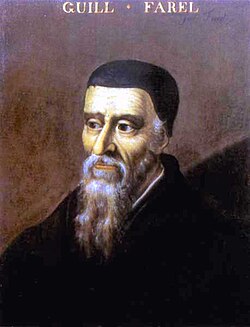
Life and Early Influences
Born in 1489 in Gap, Dauphiné, Farel was the son of a papal notary. He pursued his studies at the University of Paris, where he was influenced by pro-reform Catholic clergy and the humanist scholar Jacques Lefevre d'Etaples. This academic environment led him to a professorship in grammar and philosophy at the Collège du Cardinal Lemoine and a role as a diocesan preacher.
As a member of the Cercle de Meaux, Farel and other humanists emphasized a return to the theology of the early Church and the study of the Bible. Over time, Farel became an avid promoter of Lutheran ideas, which eventually led to conflict with the Sorbonne and forced him to evangelize in the Dauphiné region.
Exile and the Spread of the Reformation
Due to his writings against the use of images in Christian worship, Farel was forced to flee to Switzerland. His journey took him through Basel, Strasbourg, and Zürich, where he interacted with other major reformers like Huldrych Zwingli and Martin Bucer. Farel's fervent preaching led to the adoption of the Reformation in Neuchâtel in 1530.
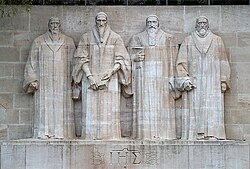
The Geneva Reformation
Farel began preaching in Geneva in 1532 under the protection of Bern. By May 1536, the General Council of Geneva had adopted the Reformation. It was during this time that Farel convinced John Calvin to stay in the city to help lead the evangelization process. However, the relationship between the church and the state government of the Republic of Geneva eventually soured, leading to the banishment of both Farel and Calvin in 1538.
Later Years and Legacy
Farel spent the remainder of his life as the first pastor of Neuchâtel. Despite his exile from Geneva, he continued to travel and consult with Calvin. In 1558, at age 69, he married Marie Thorel, an 18-year-old Huguenot refugee, a union that famously shocked John Calvin. Farel died in Neuchâtel on September 13, 1565.
Martin Bucer described Farel, Calvin, and Pierre Viret as the triumvirate of the Francophone Reformation. Farel's legacy is marked by his role as a pioneer who first brought the Reformation to cities like Meaux, Basel, Metz, Strasbourg, Neuchâtel, Geneva, and Lausanne. He also recognized the power of the printing press, installing the first fully Reformed printer in Neuchâtel and bringing Jean Girard to Geneva.
คำถามที่พบบ่อย
Who was William Farel?
William Farel was a French evangelist and Protestant reformer who founded the Reformed Church in French-speaking Switzerland and was instrumental in bringing John Calvin to Geneva.
What was Farel's relationship with John Calvin?
Farel was a mentor and ally who persuaded Calvin to stay in Geneva in 1536 and again in 1541, though they occasionally disagreed on personal matters, such as Farel's marriage to a much younger woman.
Why was Farel banished from Geneva?
Farel and Calvin were banished in 1538 due to conflicts with the government of the Republic of Geneva over the respective authority of the Church and the State.
บทความที่เกี่ยวข้อง
 01การท่องเที่ยว
การท่องเที่ยว
Neu-Isenburg เมืองแห่งประวัติศาสตร์และศูนย์กลางการค้าในเยอรมนี
อ่านบทความฉบับเต็มอ่านต่อ → 02ศาสนาและจิตวิญญาณ
John Calvin
Vocation ความหมายของ 'การทรงเรียก' ในบริบทคริสเตียนและสากล
อ่านบทความฉบับเต็มอ่านต่อ →ศาสนา