Beeldenstorm The Great Iconoclasm of the 16th Century
สรุปใจความสำคัญ
- The Beeldenstorm refers to the 16th-century destruction of religious images by Calvinist Protestants.
- The term specifically describes the wave of attacks in the Low Countries in 1566, but similar events occurred across Europe.
- Open-air 'hedgerow sermons' (hagepreken) played a significant role in mobilizing the crowds before the attacks.
The Beeldenstorm (Dutch for 'storm against statues') or Bildersturm in German, refers to the outbreaks of destruction of religious images that swept through Europe during the 16th century. Known in English as the Great Iconoclasm or Iconoclastic Fury, these events were characterized by the destruction of Catholic art, church fittings, and decorations by Calvinist Protestant crowds as part of the broader Protestant Reformation.
The Scope of Iconoclasm in Europe
While the term Beeldenstorm specifically refers to the wave of attacks in the summer of 1566 in the Low Countries, similar movements occurred across Europe between 1522 and 1566. Notable outbreaks took place in Zürich (1523), Copenhagen (1530), Münster (1534), Geneva (1535), and Augsburg (1537), as well as in Livonia between 1522 and 1524. In England, the removal of images was both government-sponsored and spontaneous from 1535 onwards, and in Scotland from 1559. France also experienced several outbreaks during the Wars of Religion starting in 1560.

Background and Causes
The drive toward iconoclasm was rooted in the religious tensions of the Reformation. In Germany, Switzerland, and England, conversion to Protestantism was often enforced at the city or kingdom level. However, the Low Countries were under the rule of Philip II of Spain, a devoted Catholic and supporter of the Counter-Reformation. Philip II attempted to suppress Protestantism through his governor-general, Margaret of Parma.
Beyond religious fervor, the region was plagued by economic discontent, poor harvests, and a harsh winter. While some historians once viewed these as primary drivers, modern scholars are less inclined to see the movement as solely prompted by economic factors. The Beeldenstorm grew from a shift in Protestant behavior around 1560, where believers became more open about their faith despite penal sanctions.

The Role of Hedgerow Sermons
Protestant views were spread through hagepreken, or "hedgerow sermons"—open-air sermons held outside town jurisdictions. These sermons, often led by Anabaptist or Mennonite preachers, attracted huge crowds and frequently preceded the iconoclastic attacks of August 1566. By 1565, the authorities' efforts to persecute heresy had slackened, giving Protestants increased confidence to act openly.
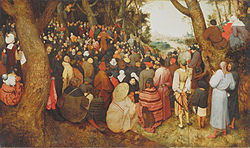
The Outbreaks of 1566
The wave of destruction began on August 10, 1566, the feast-day of Saint Lawrence. A crowd invaded and defaced the chapel of the Sint-Laurensklooster (Saint Lawrence monastery) near Hondschoote and Steenvoorde. This event sparked a rapid spread of disorder across the Low Countries from south to north, leading to the widespread destruction of religious art in churches and public spaces.
คำถามที่พบบ่อย
What does 'Beeldenstorm' mean?
Beeldenstorm is a Dutch term that literally translates to 'storm against statues' or 'attack on the images.'
Who were the primary drivers of the Beeldenstorm?
The attacks were primarily carried out by Calvinist Protestant crowds who sought to remove what they viewed as idolatry from churches and public spaces.
Why did the Low Countries experience the Beeldenstorm in 1566?
A combination of religious tension under the strict Catholic rule of Philip II of Spain, the spread of Protestantism via open-air sermons, and general economic discontent contributed to the outbreak.
บทความที่เกี่ยวข้อง
Calvinism
D. G. Hart นักประวัติศาสตร์ศาสนาและสังคมชาวอเมริกัน
อ่านบทความฉบับเต็มอ่านต่อ → 02ศาสนาและประวัติศาสตร์
Calvinism
Anglican Arminianism ความเชื่อและความขัดแย้งในคริสตจักรแห่งอังกฤษ
อ่านบทความฉบับเต็มอ่านต่อ → 03History
Protestant Reformation