The Shakespeare Coat of Arms History and Symbolism
สรุปใจความสำคัญ
- The coat of arms was granted to John Shakespeare in 1596.
- The design features a gold shield with a black diagonal bar and a gold spear with a silver head.
- The crest consists of a silver falcon supporting a gold spear.
- The motto associated with the arms is 'Non Sanz Droict', meaning 'Not without right'.
The Shakespeare coat of arms is a distinguished piece of English heraldry granted to John Shakespeare, a glover from Stratford-upon-Avon, in 1596. This heraldic achievement was subsequently used by his famous son, the playwright William Shakespeare, and other descendants of the family.
History of the Grant
The journey to obtaining a coat of arms began around 1575 when John Shakespeare made initial inquiries. It is believed he may have met Robert Cooke of the College of Arms during Cooke's visit to Warwickshire. While a pattern may have been designed at that time, economic difficulties likely prevented the formal grant, as such applications were expensive.
In 1596, the application was renewed. This second attempt was likely made by John or by William on behalf of the family. As the eldest son, William had the financial means and the social connections—including support from influential figures like Henry Wriothesley, Earl of Southampton, and Robert Devereux, Earl of Essex—to see the process through.
Two drafts of the grant document, written by the herald William Dethick, have survived. Some scholars, including palaeographer Charles Hamilton, suggest these drafts were written in William Shakespeare's own hand, providing a rare example of the playwright's handwriting.
Family Tragedy and the Arden Connection
The approval of the coat of arms was marred by personal tragedy. Hamnet, William and Anne's only son, died just a few months before the grant was finalized. This left the family without a male heir to inherit the honor, a theme of loss and "fruitless crowns" that William later explored in his play Macbeth.
In 1599, there was a request to combine (impale) the Shakespeare arms with those of the Arden family, the higher-ranked family of John's wife, Mary. While this would have elevated the family's status, the combined version was never used, possibly because William preferred the aesthetics of the original design or because the combined grant was never officially finalized.
Challenges and Disputes
The grant was not without controversy. In 1602, Ralph Brooke, a rival of William Dethick, challenged the validity of the Shakespeare arms, claiming the family did not qualify and that the design was too similar to existing arms. However, the dispute was resolved in Dethick's favor, upholding the grant.
Description and Symbolism
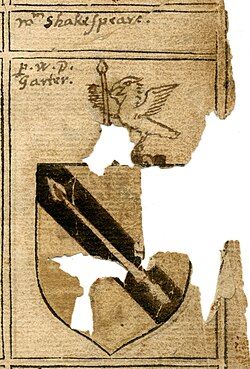
The 1596 drafts define the coat of arms as follows: Gold, on a bend sable (black diagonal bar), a spear of the first (gold), steeled argent (silver head). The crest features a silver falcon with wings displayed, standing on a wreath of the family's colors and supporting a gold spear with a silver head, all set upon a helmet with mantles and tassels.
Symbolic Meanings
- The Spear: A direct allusion to the family name "Shakespeare." Some scholars also suggest it resembles a silver-tipped golden pen, nodding to William's profession.
- The Falcon: May refer to an interest in hunting or potentially a connection to the coat of arms of Henry Wriothesley, which features silver falcons.
- The Colors: Some suggest the gold and black colors imply a history of crusading knights within the family.
The drafts also include the motto Non Sanz Droict, old French for "Not without right." Interestingly, an early version of the motto was written as Non, Sanz Droict ("No, without right"), which was later corrected.
คำถามที่พบบ่อย
Who originally applied for the Shakespeare coat of arms?
John Shakespeare, a glover from Stratford-upon-Avon, first made inquiries in 1575 and the grant was eventually finalized in 1596.
Is there a connection between the design and William Shakespeare's writing?
Some scholars suggest the spear on the shield resembles a silver-tipped golden pen, and the loss of a male heir to inherit the arms is reflected in the themes of Macbeth.
Was the Shakespeare coat of arms ever challenged?
Yes, in 1602, Ralph Brooke challenged the grant, arguing that the Shakespeares did not qualify and the design was too similar to others, but the dispute was resolved in favor of the grant.
บทความที่เกี่ยวข้อง
 01ประวัติศาสตร์
William Shakespeare
Thomas Nash สามีของหลานสาว William Shakespeare
อ่านบทความฉบับเต็มอ่านต่อ →ประวัติบุคคล
Sir James Balfour Paul ผู้เชี่ยวชาญด้านตราอาร์มแห่งสกอตแลนด์
อ่านบทความฉบับเต็มอ่านต่อ →heraldry